 Integrované územní investice v programovém období 2021–2027 | Jan Zerák, Anna Švarcová, Kristýna Drápelová, Zbyněk Šimánek
Integrated Territorial Investments in 2021-2027 Programming Period, by Jan Zerák, Anna Švarcová, Kristýna Drápelová, Zbyněk Šimánek
The article focuses on Integrated Territorial Investments (ITIs) in the 2021–2027 programming period and their role in the development of metropolitan areas and agglomerations. It explains how ITIs serve as a tool to support strategic projects that contribute to sustainable development and illustrates examples of major projects that strengthen regional competitiveness and improve the quality of life of their residents.
Vysokorychlostní tratě změní dopravu v České republice | Otakar Svoboda
High-speed Lines Will Change Transport in the Czech Republic, by Otakar Svoboda
The Czech Republic plays a crucial role as a transport crossroads in Central Europe. The designed high-speed rail system (HSR) will connect the north with the south, the east with the west of the Czech Republic and, once completed, will be integrated into the high-speed TEN-T Trans-European Transport Network. Construction will be carried out in phases and individual sections will be used prior to the entire system completion in 2050 to relieve current congestion in the corridors as soon as possible.
Vláda schválila první Územní rozvojový plán | Jana VlčkováGovernment Has Approved First Spatial Development Plan, by Jana Vlčková
The Government of the Czech Republic approved by its resolution no. 581 the first spatial development plan issued by the Ministry of Regional Development and developed by the Institute for Spatial Development on 28 August 2024. The spatial development plan is a new nationwide spatial planning tool that will be binding for the development and issuance of spatial development principles, spatial plans and regulatory plans after its first amendment.
Jaderné elektrárny ve světle povolovací legislativy | Daniel BrixNuclear Power Plants from the Perspective of Authorisation Legislation, by Daniel Brix
It is appropriate to look at the nuclear issue in more detail from the perspective of the current developments in the field of nuclear energy, where the government has taken a fundamental decision shifting the long-standing plans for the construction of nuclear power sources to the implementation of specific projects, also from the perspective of the legislative framework in which the authorisation of these energy sources is carried out. The paper presents the basic legal framework that applies to the authorisation of nuclear power sources. It focuses in more detail on the specific regulations adopted for these types of nuclear power sources in order to potentially speed up their preparation and authorisation.
Kam s českým průmyslem? | Pavel SovičkaWhere Should Czech Industry Head to? by Pavel Sovička
New plans and concepts in the field of spatial development respond to the need for a higher quality of life in cities. Former industrial zones are being transformed into residential or mixed-use developments and industry is being pushed to the outskirts of cities towards motorways. In these places, however, it often occupies agricultural land. The article describes the challenging position of industrial development in the current Czech environment – also with regard to the new legislation approved in 2024. The text uses a case study to demonstrate the major differences in the distribution of tax revenues between the Czech Republic, Austria and Germany. Unlike in neighbouring countries, the current tax budget allocation in the Czech Republic does not incentivise municipalities to pursue entrepreneurial projects on their territory that offer attractive wages and high profits.
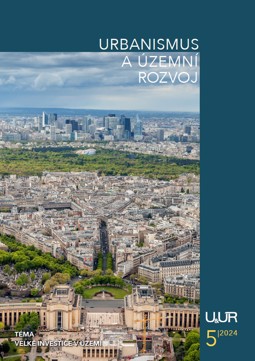
Impact of the 2024 Olympic Games on the Development of Paris Vplyv Letných olympijských hier (LOH) 2024 na urbanizmus Paríža
Impact of the 2024 Olympic Games on the Development of Paris, by Monika Šmiralová, Jarmila Husenicová
The Olympic and Paralympic Games act as a multiplier for the overall transformation of large metropolitan areas, with an increasing emphasis on the need for sustainable and inclusive development. Preparations for the 2024 Summer Olympics in Paris have triggered significant investment in the development of the transport network, the renovation of public spaces and the construction of new sports facilities. These changes have affected not only the physical shape of the city, but also its social fabric and economic development. This article analyses the impact of the 2024 Summer Olympics on the construction and transformation of Paris. It aims to assess the impacts of the Olympic Games, in particular on the urban planning, infrastructure and socio-economic dynamics of the city.
The Grand Paris Express Grand Paris ExpressThe Grand Paris Express, by Monika Šmiralová, Jarmila Husenicová
The idea of a “Greater Paris” is not new. Already in the 19th century, Napoleon III wanted to expand the capital by annexing neighbouring municipalities. The idea of building grand boulevards was also born in this period. Today, the challenges are identical, with efforts to turn Paris and its region comparable to mega-cities like Tokyo or New York. From the very beginning of thinking about a Greater Paris, transport has been considered a key factor in the construction of the new metropolis.
The Grand Paris Express is a project consisting of new fast lines and extensions of existing lines being built in the Île-de-France region of France. The creation of the Grand Paris Express aims to make some underserved areas more accessible and thus increase the supply of housing in Île-de-France, including social housing. These new developments must be part of a new model for a sustainable city.
Hrad a zámek Poběžovice | Eva VondrašováPoběžovice Castle and Chateau, by Eva Vondrašová
The West Bohemian town of Poběžovice owns the chateau, which has been declared a national cultural monument this year, however, it is in a state of collapse. The article deals with the history and rescue of this important cultural monument – the reconstruction process and the concept of the future use of the entire castle area. The planned one billion crowns for the complete reconstruction of the castle is an unrealistic investment for a city with a limited budget. It was therefore crucial to acquire funding from various subsidy programmes.
Revitalizace jezuitského komplexu budov v Klatovech | Václav ChroustRevitalization of the Jesuit Building Complex in Klatovy, by Václav Chroust
Interview with the vice-mayor of the city of Klatovy on the topic of revitalization of the former Jesuit college. Such a large-scale reconstruction is very demanding for the city from the point of view of finance, design and organization. The revitalization has taken place gradually, with the cooperation of the city administration, the public, architects and other experts, and the whole complex of buildings of the former Jesuit college is becoming an important cultural centre of the city.
Nové nařízení EU k rozvoji sítě TEN-T a další dopravní sektorové strategie 3. fáze | František Nantl
Dostavba lokality Medlánky | Jiří Gerö
QGIS User Conference 2024 | Tomáš Zvardoň