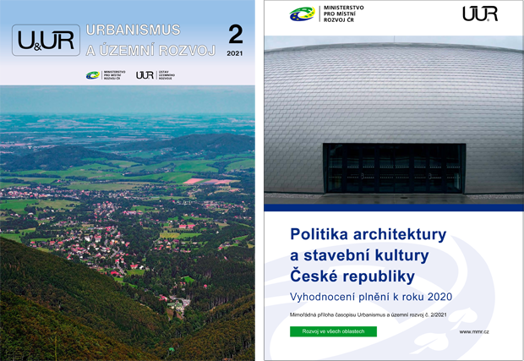
Kliknutím na obálku zobrazíte celé číslo.

Evaluation of the implementation of Architecture and Building Culture Policy of the Czech Republic and its update, by Josef Morkus
By Decree 287 dated 15 March 2021, the Government of the Czech Republic has accepted an evaluation document addressing the implementation of Architecture and Building Culture Policy of the Czech Republic by 2020. At the time that this evaluation document was accepted, work on an update of the document covering the period up to 2022 was assigned. It is expected that the update will take into consideration Update Suggestions, a working material that has already been prepared.
The spatial study of Pustevny, by Kateřina Vrbová
This article presents a spatial study elaborated by the Ministry for Regional Development that should serve as a basis for the coordination and direction of prospective developments on the territory of Pustevny, an important tourism destination on the border of the Regions of Moravia-Silesia and Zlín. In what does the genius loci of Pustevny consist, and can a limit for the number of visitors be determined that will ensure the survival of natural, cultural and landscape values? What will the sustainable development of this territory be like in the near future? Debates with supporters of various interests and the quest for answers to these questions have proved that a consensus will be difficult to achieve, although it will be crucially important for coordinated sustainable development of this territory.
A series of publications by the Ministry for Regional Development: Methodological aids for education of municipal representatives and other stakeholders in spatial development, by Richard Nikischer, Ivana Svojtková
The Ministry for Regional Development has published a series of editions entitled The Ministry’s Publications for Municipalities. The objective of this series is to provide representatives of municipalities with procedures and examples of good practice in various domains of municipal administration, therefore contributing to information-based and knowledge-based spatial administration and development. The target group of readers is mainly composed of representatives of small settlements, but the content will be of interest and use to many other stakeholders as well. The publications put stress on current and socially relevant subjects. Using simple, instructive and visually appealing methods, they will be attractive to a wider audience, too. Individual chapters are written by leading specialists who have followed the initiative of the Ministry for Regional Development in deciding to share their knowledge and experience with a wider audience of readers and users.
An analysis of spatial landscape studies, by Markéta Müllerová
The aim of this article is to summarize the results of an analysis of spatial landscape studies published as parts of diploma theses. The sample of these documents consisted of six spatial studies elaborated between 2016 and 2019, supported by Integrated Regional Operational Programmes. The objectives of this analysis were to compare these landscape studies, explore the various approaches the authors took when solving comparable problems, and find common solutions. Most attention was paid to the resulting proposals and recommendations. The outcome of the analysis may serve as a useful basis for prospective spatial studies.
Reciprocal influence of urban planning parameters of sustainability in a residential zone, by Karol Görner and Lucia Štefancová
Sustainability is now an inseparable part of urban and spatial planning. However, mutual relations among elements of settlement structures are not yet fully understood. The best way to design sustainable urban concepts is still open to question. The aim of this article is to analyse sustainability by means of a description of urban planning parameters in the context of a residential zone and, subsequently, to examine the relations among these parameters. The study analysed ten selected parameters and came to the conclusion that it is of key importance for sustainable urban planning concepts of residential zones that the context of functional/spatial relations is complemented by a definition of appropriate intensity of housebuilding. It is evident that more specific environmental aspects and the creation of public space are matters for more detailed levels of documentation of buildings and public space.
The development of neighbouring satellite settlements: Linkage by a common multifunctional centre, by Ema Ruhigová, Roman Ruhig, Mária Bogárová and Michal Bogár
This article addresses a highly topical matter: the spread of satellite settlements to make larger agglomerations. Besides creating necessary housing capacity, the development of these settlements has a lot of negative impacts on natural settings and the landscape. This article identifies these negative impacts and pinpoints possible solutions that would both guarantee the necessary capacity and eliminate environmental impacts from an overloaded transportation infrastructure. The example is given of Miloslavov, a settlement 10 kilometres from Bratislava, Slovakia’s capital, which is the site of an uncontrolled construction boom in a suburban area. A village experiencing intensive growth, it comprises two neighbouring suburban settlements that have already been united administratively but are still separated physically by an undeveloped territory. It is expected that a new multifunctional centre of public facilities will be built in this unoccupied zone, linking the new housing capacity in a logical whole with a new identity.