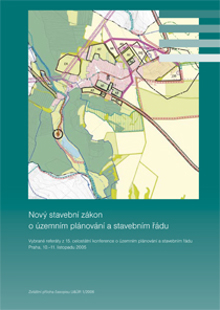
 15. celostátní konference o územním plánování a stavebním řádu
15th National Conference on Physical Planning and the Building Code, editorial
The 15th Conference on physical planning took place on 10–11 November 2005 in Prague. The tradition of regular conferences is based on events organized annualy in the town of Carlsbad before 1991, followed then by meetings in various Czech locations. The conference was focused on the new Building Act. By coincidence, the draft of the Act was being discussed by the Parliament of the Czech Republic on the days of the conference. On one hand, this made it impossible for the representatives of the Ministry for Regional Development’s Physical Planning Department (thus the authors of the Act) to paritcipate, but on the other hand, the participants could immediately get information about the current state of the debate. The Act has now been ratified by the Chambers of Deputies and commented on by the Senate. In the supplement to this issue of UPSD you will find some selected speeches and a summary of the conference.
Architektonické a urbanistické aspekty panelovej výstavby v Bratislave | Henrieta Moravčíková, Matúš Dulla, Katarína Haberlandová, Mária Topolčanská, Slávka DoricováArchitectonic and Urban Planning Aspects of the Construction of Prefab Housing Blocks in Bratislava, by Henrieta Moravčíková, Slávka Doricová, Matúš Dulla, Katarína Haberlandová, Mária Topolčanská
In Slovakia the mass housing construction is viewed as a typical example of the failure of the ideals of modern architecture. The construction of prefabricated blocks of flats has annihilated the ideas of modern urban planning, its typification and unification, and the whole system of the communist building industry. The situation under which the state was the developer, the constructor, and the architect at the same time, has liquidated any economic competition, imposing tragic consequences for the Slovak building industry: no responsibility for the work, decrease in productivity, and the bad quality. There were some objections against such massive development as soon as in the 1960s but no comprehensive analysis was made before the end of the 1980s. The construction of prefabricated blocks of flats belonged to the agenda of the totalitarian rule — such technology constituting 93.5 % of the housing construction in the former Czechoslovakia — so criticism could hardly work before the fall of the regime. Nevertheless, it is to say that such blocks of flats did help to solve the problem of lacking dwellings. It was between 1971 and 1980 when 1,261,000 flats were built, offering fair spatial and hygienic standards to most of their inhabitants. The prefab housing estates still make up a substantial part of the environment of Slovak towns and cities, which is another reason for us to approach them in a constructive manner, instead of a desultory rejection.
Brno v proudu změn. Proměny vnitřní struktury Brna z pohledu vlivů globálních trendů | Michaela ŠuleřováBrno in the Progress of Changes: Metamorphoses of the City’s Inner Structure from the Viewpoint of Global Trends, by Michaela Šuleřová
Cities all over the world are undergoing changes, reflecting the new progress and trends in the society. Another wave of suburbanization, gentrification, commercialization, town centre revitalization, and other processes have had their impact on the look of cities. A medium-sized European city, Brno could not avoid such changes or stay off the global developments. Rather than an analysis of all the types of Brno’s urban landscape, the aim of this article is to outline the spatial (and, consequently, social) metamorphoses of the city as a result of the worldwide social, economic, cultural, and political changes.
Informace z konference o územním plánování a stavebním řádu, Praha 2005 | Miriam Blažková
Větrné elektrárny a územní plánování | Jiří Cibulka, Petr Lepeška Lesk a bída měst | Radko Martínek Vize je uměním vidět věci neviditelné. Seminář INTERACT v Miláně | Lubor Fridrich
Národní rozvojový plán ČR 2007–2013: budoucnost programů fondů Evropské unie | Tisková zpráva MMR Bydlení bude od roku 2007 možné financovat z evropských zdrojů | Tisková zpráva MMR Nový stavební zákon o územním plánování a stavebním řádu