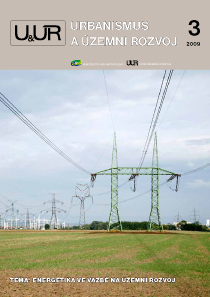
 Evropské a přeshraniční vazby technické infrastruktury České republiky za oblast energetiky | Jiří Ptáček, Petr Modlitba, Lukáš Hádek, Pavel Louženský
European and Crossborder Linkages of the Czech Technical Infrastructure in Energetics, by Jiří Ptáček, Petr Modlitba, Lukáš Hádek, Pavel Louženský
This article is concerned with the technical infrastructure of the Czech Republic, both in the European context and that of the links to the neighbouring countries. Discussed is the technical infrastructure in energetics, namely transmission lines of electricity, gas mains and oil pipelines. For each of these branches the situation of the Czech Republic is described, enumerating the European or crossborder intents (those under preparation and being materialized). The contribution consists of texts of four authors.
Technická infrastruktura v Politice územního rozvoje České republiky 2008 – energetika | Marie Polešáková
Technical Infrastructure in the 2008 Spatial Development Policy of the Czech Republic: Energetics, by Marie Polešáková
This contribution deals with energy industries within the 2008 Spatial Development Policy, a strategic document based on the 183/2006 Building Act of the Czech Republic. Energy systems of international and national coverage and the related resources in electricity, gas and oil supply are discussed at the level of transmission and transit networks.
Plánovací smlouva | Marie Polešáková
The Planning Contract, by Marie Polešáková
The planning contract is a new legal institute established by the 183/2006 Building Act as a tool to support participation, especially in the co-financing of the public infrastructure as a precondition for public decision-making about regulatory plans and the emplacement of buildings. Also, such tool enables developers to initiatively prepare their projects.
Vláda ČR schválila návrh Politiky územního rozvoje České republiky 2008 | Martin Tunka, Filip Novosád, Daniela Lešková
Draft of the 2008 Czech Spatial Development Policy Approved by the Government, by Martin Tunka, Filip Novosád, Daniela Lešková
On 20 July 2009 the Government of the Czech Republic approved the draft of the 2008 Spatial Development Policy as worked out by Ministry for Regional Development. The draft was being prepared and elaborated under close and persistent cooperation of Regions, Ministries and other authorities of central administration. Since the preliminary period of the preparatives, active influence on the process could have been exerted by the public, with the working version of the document continuously available on the website of the Ministry for Regional Development.
Setkání ministrů pro regionální rozvoj v Mariánských Lázních | Daniela Grabmüllerová
Regional Development Ministers’ Meeting in Mariánské Lázně, by Daniela Grabmüllerová
An informal meeting of the EU member states’ ministers in charge of regional development was the most important event of the Czech Ministry for Regional Development during the Czech Presidency of the Council of the EU. Chaired by Mr Cyril Svoboda, the Minister for Regional Development, the meeting took place from 22 to 24 April 2009 in Mariánské Lázně, hosting ministerial delegations of all 27 EU member states and Croatia, Turkey, Norway, and Switzerland. Representatives of international institutions like the European Commission, the European Parliament, the Committee of the Regions, the European Economic and Social Committee, the European Investment Bank, and the OECD participated, too. The main objective of the debate was to agree upon the basic principles of the future cohesion policy which covers more than one third of the total EU budget. EU Ministers approved a joint communiqué which is the document reflecting the current state of play of the European political debate on the future cohesion policy.
Zavádění územně analytických podkladů obcí a krajů je již podpořeno z prostředků EU | Jarmila Svobodová
Implementation of the Documents of Spatial Analysis Supported from EU Funds Now, by Jarmila Svobodová
Although the 2007 to 2013 planning period still seems to be at its beginnings, some projects have been terminated and the respective EU fund subsidies discharged. This is true for a part of the Integrated Operational Programme too, namely the first invitation for applications as published on 10th April 2008. Through this invitation, projects have been supported to implement the documents of spatial analysis in Regions and municipalities. This article can therefore present the first outcome of the programme, giving the number of supported projects and the information about the amounts of financial means used. All the data are provided by the Centre for Regional Development of the Czech Republic as the mediating and monitoring subject within the Integrated Operational Programme.
Elektřina jako univerzální energie – nároky na přenosovou soustavu | Kolektiv ČEPSElectricity as Universal Energy – Requirements for the Transmission System, by a ČEPS team
This article reviews the problems of electricity transmission in the Czech Republic, carried out by ČEPS (The Czech Republic Transmission System Operator), reflecting on the importance of the backbone transmission system and its connection to the neighbouring countries, the requirements for the system and its reliability, and the investments in the equipment of the system. Analysed in detail is the legislative, procedural, spatial, constructional and technical context of the construction of new transmission lines, overhead and underground.
Využití webového portálu pro řešení problematiky ÚAP ve skupině ČEZ | František FialaČEZ Using a Web Portal to Handle the Documents of Spatial Analysis, by František Fiala
ČEZ was one of the first corporations to use an internet portal for the transfer of data required for the documents of spatial analysis. More than a year has passed from the launch, so the first objective experience of the operation and utilization can be presented here.
Ceny elektřiny vyrobené z obnovitelných zdrojů | Stanislav Trávníček
Prices of Electricity from Renewable Resources, by Stanislav Trávníček
Essential for the development of renewable resources of electricity in the Czech Republic are the economic conditions created through the regulated prices for production. This article summarizes the ways in which the amount of such support is determined, describing its forms, application, impact on consumers, and other related aspects.
Duchovní význam místa jako hodnota území | Jiří KupkaThe Spiritual Importance of a Place as Value of Territory, by Jiří Kupka
There are several locations possessing a certain immaterial importance, participating in the creation of the particularity and proper identity of the landscape. Among the spiritual or immaterial values of the landscape, there are locations related to mythology, legends and the oldest origins of the Czech history, those linked to the stories of the oldest chronicles and records of time, or those important for the local history or literature or the life and work of historic or legendary figures. Though such places are usually connected to material values or those of monuments of natural sights, the substance of their valuability is more deeply rooted in the priceless historic memory and uniqueness. In this view, the spiritual value of the location also in the physical planning practice should be taken into consideration as one of the territory values, which represents one of the competent restrictions, but also a worthwhile opportunity for the presentation and development of space.
Informace o spolupráci ČSRES s MMR a ÚÚR při výkladu stavebního zákona se zaměřením na elektroenergetiku | Alexandr Gall Metodiky MMR k obnovitelným zdrojům | Naděžda Rozmanová Mezinárodní konference o budoucnosti kohezní politiky EU | Daniela Grabmüllerová
Open seminář programU ESPON v Praze | Lubor Fridrich
Cestovní ruch – současné a budoucí výzvy pro územní rozvoj. Mezinárodní výroční konference IFHP 2009 | Marie Tomíšková Územní plánování a GIS | Jaroslav Burian