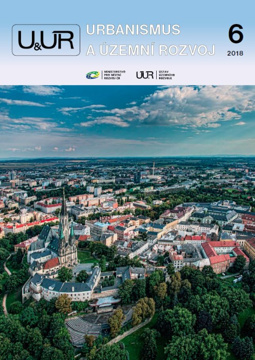
Kliknutím na obálku zobrazíte celé číslo.
 Vyhodnocení územních nároků průmyslových zón. Nová metodika Ministerstva průmyslu a obchodu | Veronika Šindlerová, Jan Hana
Evaluation of territorial claims for industrial zones: A new methodology implemented by the Ministry of Industry and Trade, by Veronika Šindlerová, Jan Hana
State-subsidised industrial zones have been developed within the Programme for Support of Business Property and Transportation Infrastructure since 1999. The aim of the funding has been to prepare integrated plots for important foreign developers and support creation of new jobs, particularly in structurally deprived regions. On one hand, industrial zones generate economic benefits for these regions and, frequently, the whole country. At the same time, however, they overburden territories in their surroundings and beyond. One of the tasks of planning and, subsequently, projects of industrial zones should be to assess territorial claims and take measures to secure and saturate the claims identified. The new methodology implemented by the Ministry of Industry and Trade of the Czech Republic is intended for this purpose.
Konstrukce výběrového souboru průzkumů dopravního chování pro účely městského plánování | Petr Kouřil, Vít Gabrhel, Michal Šimeček, Daniel Szabó, Marek TögelConstruction of a sample set for urban planning research in transport behaviour, by Petr Kouřil, Vít Gabrhel, Michal Šimeček, Daniel Szabó, Marek Tögel
High-quality planning of urban transportation is not feasible without knowledge of transport behaviour of inhabitants. Transport behaviour is identified by questionnaire surveys which detect from where, to where, by which means of transportation, and for what purpose people travel. A key factor in a reliable investigation is the construction of a sample set representing the whole population based on a limited number of units. This article describes how a sample set for urban questionnaire surveys is constructed and gives recommendations for how data on transport behaviour can commonly be used.
Olomoucká zkušenost s IROP | Jana Křenková, Petra Růžičková, Jiří ŠobrRegulatory plans and studies for public space: IROP experience from Olomouc, by Jana Křenková, Petra Růžičková, Jiří Šobr
The statutory city of Olomouc has taken advantage of the opportunity to apply for subsidies for spatial planning documents from the Integrated Regional Operational Programme, namely for regulatory plans for housing estates and a spatial study for a public space located in the Urban Conservation Area of Olomouc. The article describes the process of elaborating regulatory plans and spatial studies for public space in the historic town of Olomouc.
Výstupy projektu TRANSGREEN. Relevantné aj pre územné plánovanie | Ľubomír Jamečný, Vladimír Ondrejička, Milan HusárTransgreen project outcome relevant for spatial planning, by Ľubomír Jamečný, Vladimír Ondrejička, Milan Husár
The World Wildlife Fund has combined the forces of experts in transportation, spatial planning and environmental protection in the region of the Carpathians in order to elaborate Transgreen, a project subtitled Integrated transport and green infrastructure planning in the Danube-Carpathian region for the benefit of people and nature. Supported by the Danube Transnational Programme, the project was focused on procedures, measures and tools for the building of road and rail infrastructure while respecting the needs of animals in the wild. Transgreen has brought together 11 regular and 9 associated partners, most of them institutions and research centres involved in policy-making and building of transportation infrastructure and environmental protection in the countries of the Carpathians region: Slovakia, the Czech Republic, Hungary, Romania, Austria and Ukraine.
Celostátní seminář k problematice lidového stavitelství | Marie Tomíšková