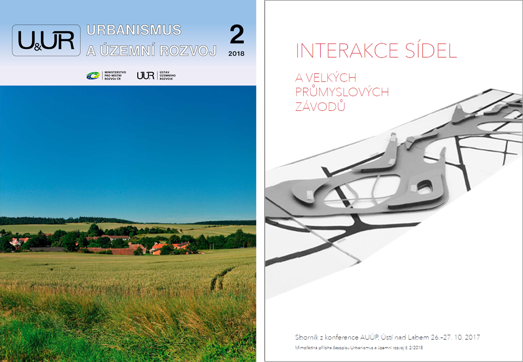
Kliknutím na obálku zobrazíte celé číslo.
 Závazné stanovisko orgánu územního plánování | Josef Morkus
Binding statements by bodies of spatial planning, by Josef Morkus
As an amendment to Czech Building Act 183/2006, the Act 225/2017 came into force on 1 January 2018. One of the most important changes implemented by this amendment is a new approach to the assessment of conformity between spatial plans and the policy, objectives, tasks and documents of spatial development. This conformity has, in most cases, recently come to be evaluated by spatial planning bodies instead of the Building Offices. The main reason for the transfer of this duty to bodies of spatial planning is that the amendment has enlarged the range of authorities that locate and approve construction, making it necessary to establish an institution for the coordination of plans in particular territories.
Strategie regionálního rozvoje ČR pokračuje tvorbou návrhové části | Zdeněk Opravil
Making the propositional part of the Strategy of Regional Development of the Czech Republic, by Zdeněk Opravil
This article summarizes current information on the creation of the Strategy of Regional Development of the Czech Republic, a national strategic document. The article presents five basic chapters that constitute the basis for the propositional part of the document. A basic outline of the strategic objectives and visions of the proposal is presented as well.
Metodika vymezování územního systému ekologické stability | Eva Voženílková
Methodology for delimitation of territorial systems of environmental stability, by Eva Voženílková
As part of Call 52 of the Operational Programme Environment 2014–2020, in early May 2017 the Ministry of the Environment published the document Methodology for delimitation of territorial systems of environmental stability. This is a professional methodology tool for the delimitation of territorial systems of environmental stability under the terms of Act 114/1992 on Nature and Landscape Protection for the defining of systems of environmental stability that make possible the preservation and reproduction of natural wealth, influence less stable parts of the landscape and create a basis for its varied use. The assessment is carried out by bodies of spatial planning and environmental protection in cooperation with authorities responsible for water management, land resource protection and forestry administration.
Dostupnost veřejných infrastruktur | Karel Maier, Veronika ŠindlerováAvailability of public infrastructure, by Karel Maier, Veronika Šindlerová
According to the document Policy of Architecture and Building Culture of the Czech Republic, authorized by the Government in 2015, the Ministry for Regional Development is entrusted with the definition of availability/capacity standards for public facilities and availability standards for public areas. To achieve this, the Ministry must cooperate with the Institute for Spatial Development, the Association for Urban and Regional Planning and higher education institutions. This article presents the standards originated as part of the execution of this assignment as they apply to spatial planning. These standards focus mainly on the accessibility of basic public facilities, which has not been regulated by Czech urban planning for the last three decades, taking into consideration a variety of negative consequences, notably the rapid growth of suburbs of big cities.
Případová studie – analýza problematiky ochrany přírody a ekologické stability krajiny jako součást územní studie krajiny SO ORP Znojmo | Tamara FaberováA case study: Analysis of the problems of nature protection and environmental stability as part of a spatial study of landscape administered by municipalities with extended powers in the district of Znojmo, by Tamara Faberová
The spatial studies of landscapes currently available provide a unique opportunity to better incorporate a concern for nature protection into spatial planning. This article describes the results of analyses of nature protection and environmental stability carried out within a spatial study of landscape administered by municipalities with extended powers in the district of Znojmo. The researchers created their own methodology for the assessment of territorial problems and values. Five parameters are stipulated and quantified in terms of nature protection: surface area of territories of particular protection, coefficient of environmental stability, shifts in environmentally stable areas between 2005 and 2016, surface area of biotopes, and threat to migration corridors and significant migration territories of large mammals. Problems in municipal territories are expressed using a scale from 0 (no problems and/or natural values well preserved) to 3 (significant problems and/or natural values almost absent). The results identify territories with well-preserved natural values and sufficient protection and those with valuable locations that should be subject to greater protection. Developments in the size of environmentally stable areas are described and municipalities with a very low number of valuable locations, including some which have deteriorated during the last decade, are identified. Valuable but unprotected biotopes and migration territories and corridors endangered by housing are delimited. The results also provide information on the gravity of the situation in particular municipalities. The article summarizes the results of the study’s analytical part, which will be used for specifi c recommendations.
(Ne)účast spolků při ochraně přírody v územním a stavebním řízení | Tereza SnopkováParticipation (or non-participation) of associations in environmental protection during spatial and pre-construction proceedings, by Tereza Snopková
Since 1989, legislation in environmental protection has become a respected constituent of the Czech legal system. It is a comprehensive branch of jurisprudence comprising legislation, taxonomy and tools. An important tool for environmental protection is the participation of the public in connection with the right to receive information on the environment.
Územní plánování a veřejný prostor. 25. ročník soutěže Stavba roku 2017, Urbanistický projekt roku 2017 | Jan Fibiger
Nejlepší urbanistický projekt. Výsledky XXIII. ročníku mezinárodní studentské soutěže | Zuzana Poláková
Holašovice v kontextu jihočeské venkovské architektury; Schwarzenberská krajina Hlubocka a Třeboňska. Recenze publikací | Tomáš Kučera
Metodika hodnocení vlivů na krajinné památkové zóny | Jakub Kotrla Urbis Smart City Fair | Vladimíra Labounková Interakce sídel a velkých průmyslových závodů