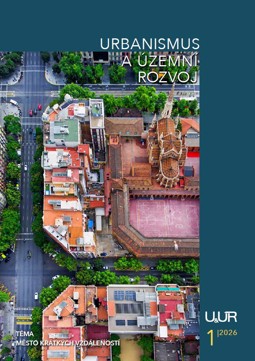
Kliknutím na obálku zobrazíte celé číslo.
 Město krátkých vzdáleností jako průřezový princip politik MMR | Věra-Karin Brázová, Karel Wirth
The City of Short Distances as a Cross-Cutting Principle of the Ministry of Regional Development’s Policies, by Věra-Karin Brázová, Karel Wirth
This article examines how the principle of the city of short distances has been reflected in the strategic and conceptual documents of the Ministry of Regional Development. It shows that this approach is not an isolated concept but rather a cross-cutting principle that supports sustainable development, quality of life, and the resilience of settlements through the instruments of urban policy, Smart Cities, and spatial planning.
A City of Short Distances or Suburbs of Reasonable Proximities? Exploring the Potential of Soft Densification in Prague Suburban Municipalities Město krátkých vzdáleností, nebo předměstí s přijatelnou dostupností? Zkoumání potenciálu měkkého zahušťování v příměstských obcích Prahy A City of Short Distances or Suburbs of Reasonable Proximities? Exploring the Potential of Soft Densification in Prague Suburban Municipalities, by Jana Nádravská, David
Although the city of short distances is a strategy embraced by many global cities, concerns have been raised about the practical feasibility of the concept in cities with an existing sprawling structure, i.e., cities surrounded by low-density suburbs and satellite municipalities. One answer is to extend the 15-minute city concept and modify it for low-density fringes. This article presents strategies and initiatives that follow and extend urban proximity concepts to suburban areas and summarizes their main ideas. One of the consensus identified across these strategies is the necessity of increasing the population density in low-density localities. The empirical part of the study investigates the potential for increasing density using GIS analysis in the suburbs of the Central Bohemian Region. The analysis specifically models the impact of soft densification – a Western European bottom-up strategy involving incremental changes on private plots, initiated by residents.
Analýza podmínek pro doručování na poslední míli v podmínkách města krátkých vzdáleností | Michaela Ledvinová, Andrea Seidlová, David ŠourekAnalysis of Conditions for Last-Mile Delivery in the Context of the City of Short Distances, by Michaela Ledvinová, Andrea Seidlová, David Šourek
The concept of the city of short distances assumes that residents can reach all basic amenities within a short travel time, supported by the efficient use of walking, cycling, and public transport in particular. This article focuses on available solutions for last-mile parcel delivery in the conditions of the Czech Republic, with particular attention to parcel lockers, so that the concept can meet both residents’ needs and the urban planning principles of the city. The article analyses customers’ decision-making processes when choosing parcel delivery options and identifies the factors influencing these decisions.
Shared Streets as a Tool for Improving the ”City of Short Distances” Sdílený uliční prostor jako nástroj pro zlepšení „města krátkých vzdáleností“ Shared Streets as a Tool for Improving the ”City of Short Distances”, by Valentina Orioli
Mobility design is an essential element in the creation of the “city of short distances.“ The “shared street“ model, in its many operational forms, is one of the design tools for transitioning mobility towards a more equitable model, both from social and environmental points of view. After discussing the theoretical premises, the paper presents the experience gained in this field by the City of Bologna, in particular through the project Bologna a scuola si muove sostenibile (Bologna moves sustainably at school).
Vídeň – město krátkých vzdáleností | Gabriele Berauschek, Barbara SlottaVienna – a City of Short Distances, by Gabriele Berauschek, Barbara Slotta
Vienna is a city with multiple centres that shape the character of the city as a whole, as well as of its municipal districts and individual neighbourhoods, resulting from its historical development. This is partly the result of historical processes (for example, districts dating from the Gründerzeit period), but often also a consequence of modern urban planning aimed specifically at creating vibrant and diverse centres offering a wide range of amenities and services. The concept of the 15-minute city is supported by promoting and further developing this polycentric structure. It is important to strengthen these centres to provide easy accessibility to public amenities and services and thereby promote fast and convenient access to a wide variety of functions. Vienna has a well-established tradition in this respect.
Kritická reflexe konceptu 15minutového města: synergie prostorových a sociálních ukazatelů | Anna RomanchukCritical Reflection on the 15-Minute City Concept: Synergies of Spatial and Social Indicators, by Anna Romanchuk
The article explores the quality of urban environments in the context of the short-distance city concept. It focuses on the interconnection of spatial and social aspects that influence everyday urban experience, the sense of belonging, and the level of interaction among residents. Based on scholarly literature (Newman & Kenworthy, Hnilička, Speck, Alexander), key indicators are identified, such as building density, walkability, functional diversity, and emotional attachment to space. The text further introduces the Power of 10+ concept and the tool of emotional mapping as means for participatory planning and evaluation of public space. The outcome is a set of concrete indicators that can serve as a foundation for sensitive and inclusive urban design, fostering spontaneous interactions, safety, and community life.
Historie v kruhu: městské prstence Brna, Krakova, Košic a Segedínu | Adam GuzdekHistory in a Circle: Urban Ring Structures of Brno, Kraków, Košice, and Szeged, by Adam Guzdek
The paper summarises the results of an international research project focused on the origin and development of ring urban structures in the Central European cities of Brno, Kraków, Košice, and Szeged. It demonstrates that urban ring structures emerged in different historical contexts, yet played a crucial role in the transformation of historic cities into modern urban entities. Their development was associated with the demolition of fortification systems and the gradual loosening of regulations governing them in Brno, Kraków, and Košice, whereas in Szeged, the ring structure became part of a regulatory urban concept created after a devastating natural disaster. The paper highlights the different modes of origin and the gradual transformation of these structures, which evolved from former defensive or protective elements into urban streets, public spaces, and significant elements of the spatial organisation of the city. The comparative perspective also shows that their final form was shaped by a combination of military, technical, political, and urban planning factors. The paper thus contributes to a better understanding of the role of ring structures in the development of Central European cities in the 19th and 20th centuries.
Budoucnost evropských měst v Praze | Tomáš Seko
Jubilejní 30. ročník mezinárodní studentské soutěže Urban Design Award | Zuzana Poláková