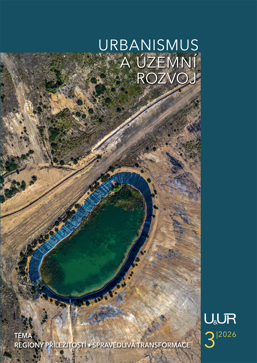
 Operační program Spravedlivá transformace: nástroj proměny uhelných regionů | Kolektiv autorů Ministerstva životního prostředí
Operational Programme Just Transition: A Tool for Transforming Coal Regions, by collective of authors, Ministry of the Environment of the Czech Republic
The transition to a climate-neutral economy does not affect the same regions equally. The Operational Programme Just Transition (OPJT) responds to this challenge by using European Union funding to support the regions which are most severely affected by the shift away from coal. The programme supports the Karlovy Vary, Ústí nad Labem and Moravian-Silesian Regions in the Czech Republic by addressing the immediate impacts of the transition while also shaping their long-term development. It links revitalisation investments in the affected areas with the development of the local economy and human potential, strengthening the knowledge base and enhancing the regions’ capacity to plan and manage their own transition.
RE:START – systémová podpora transformace strukturálně postižených regionů | Tomáš BurdychRE:START – Systemic Support for the Transformation of Structurally Disadvantaged Regions, by Tomáš Burdych
The article presents the strategy for supporting structurally disadvantaged regions by the Ministry of Regional Development. It focuses primarily on the RE:START government strategy and the activities of its executive team, which links the needs of the Ústí nad Labem, Moravian-Silesian and Karlovy Vary Regions with national decision-making and available funding tools. It also shows how regional needs have been transferred into specific measures and tasks for individual governmental ministries through action plans.
Změny č. 1a a č. 2 Územního rozvojového plánu nabyly účinnosti | Josef Morkus, Karel Wirth
Amendments No. 1a and No. 2 to the Spatial Development Plan Have Entered into Force, by Josef Morkus, Karel Wirth
The Spatial Development Plan became a legally binding spatial planning document when Amendment No. 1a entered into force on 18 July 2026. Shortly afterwards, Amendment No. 2 to the Spatial Development Plan, which delimits acceleration areas to facilitate the accelerated usage of renewable energy sources, was approved and entered into force on 25 August 2026.
Lessons Learned from the Planning Mechanisms of the Just Transition in Hungary  Zkušenosti z mechanismů pro plánování spravedlivé transformace v Maďarsku
Lessons Learned from the Planning Mechanisms of the Just Transition in Hungary, by Balázs Hegyi, Ádám Gyurkó, Zsuzsa Piskóti-Kovács
The European Union’s Just Transition Mechanism seeks to address the socio-economic consequences of decarbonization in coal-dependent regions by promoting structurally transformative and territorially just development pathways. This paper examines the planning mechanisms of the just transition in Hungary, focusing on Heves and Borsod-Abaúj-Zemplén counties. Interpreting just transition as a policy-driven process of economic diversification, the study assesses whether institutional structures, participation processes, and multi-level governance arrangements support the development of coherent diversification strategies.
The analysis is based on qualitative content analysis of EU and national policy documents, Territorial Just Transition Plans, and related institutional materials. Results indicate that the Hungarian model is procedurally well-developed: broad stakeholder involvement, partnership forums, and coordination mechanisms were formally established. However, their contribution to substantive economic diversification remains limited. Participation and partnership primarily reinforced communication and procedural compliance, while capacity constraints, institutional instability, and regulatory rigidities reduced the scope for integrated, long-term structural transformation.
The paper concludes that, in the Hungarian case, procedural robustness does not automatically translate into transformative capacity. Strengthening implementation capacities and project-generation mechanisms is essential to convert established governance frameworks into effective diversification outcomes.
Evidence vyhlídkových míst v ÚAP jako podklad pro hodnocení vizuálních dopadů v krajině | Lenka Hromková, Jan Caha, Ludmila Floková, Ilona Zourková, Sára Imreová, Karolína HynštováInventory of Viewpoints in Spatial Analytical Documents as a Basis for Assessing Visual Impacts on the Landscape, by Lenka Hromková, Jan Caha, Ludmila Floková, Ilona Zourková, Sára Imreová, Karolína Hynštová
The inventory of viewpoints in Spatial Analytical Documents (SAD) can help provide a general assessment of landscape visual values in a selected set of locations and viewing directions to assess changes in the territory. The article examines how the viewpoints are recorded in SAD of municipalities with extended powers in Moravia, and what opportunities and limitations this record creates for selecting reference observation points. The empirical part of the study is based on the analysis of publicly available SAD for 69 municipalities with extended powers, a supplementary review of 16 spatial landscape studies, and a comparison with community-generated data from OpenStreetMap. Methods included content analysis of the textual and graphical components of the SAD, comparison of the number and density of point records, a typological assessment of the records’ usability, and an indicative Spearman correlation analysis. The results show that viewpoints are recorded relatively frequently in SAD, but their usability is restricted by inconsistent levels of detail and weak interpretative contextualisation of the records, including the absence of information on the direction or extent of the view. The comparison with OpenStreetMap also reveals a difference between institutional and community-based records. The article supports the conclusion that, even following changes to the legal framework, there is value in systematically recording viewpoints and observation points as part of work with spatial values. Maintaining such a record in advance can establish a reference network of locations that can be subsequently supplemented, depending on the nature of the change being assessed.
Spravedlivá transformace a regiony příležitostí: Quo vadis územní dimenze regionální politiky? | Pavla SliwkováJust Transition and Opportunity Regions: The Spatial Dimension of Regional Policy – Quo Vadis? By Pavla Sliwková
The article addresses the comparison of two relatively new approaches to the spatial dimension of regional policy in the Czech Republic – the concept of Opportunity Regions and Just Transition. While the Just Transition concept, as a legally anchored tool of European Union cohesion policy implemented through the Just Transition Fund, represents a programme-based tool with a defined financial allocation and implementation structure, the Opportunity Regions concept, developed by the Ministry of Regional Development, currently operates primarily as a strategic and coordination framework without its own dedicated funding. The article demonstrates, based on a comparison and a case study of the Moravian-Silesian Region, that the effectiveness key factor of the spatial dimension depends both on the quality of the strategic framework and the availability of funding allocated specifically to the territory concerned together with the implementation mechanisms. It, at the same time, highlights that dedicated funding alone does not guarantee success without sufficient absorption capacity and institutional stability. The article also points to the potential of the Opportunity Regions concept in the context of the development of the programme periods after 2028 as a possible tool for the systematic support of structurally disadvantaged regions and vulnerable territories.
Operační program Spravedlivá transformace – nežádoucí odchylka, nebo vzor? | Jiří StarýOperational Programme Just Transition – an Unwanted Deviation or a Model to Follow? By Jiří Starý
The article focuses on the specific procedural and institutional arrangements of the Operational Programme Just Transition (OPJT) in the context of the transformation of the Czech coal regions – specifically the Ústí nad Labem, Moravian-Silesian and Karlovy Vary Regions. It analyses how the OPJT moves beyond the traditional sectoral approach to the implementation of European Union cohesion policy in the Czech Republic and strengthens the principles of the spatial dimension, partnership and the bottom-up approach. Particular attention is paid to the role of regional stakeholders and Regional Permanent Conferences, programme flexibility, support for integrated projects, and the use of innovative implementation schemes, such as strategic and umbrella projects. The article also highlights the challenges associated with programme implementation, particularly changing conditions and the difficult navigation in the programme for applicants. Nevertheless, the OPJT has been assessed as a significant step forward from the rigid, sector-oriented system of European funding in the Czech Republic. The article concludes that the experience gained from OPJT implementation could provide important inspiration for the design of cohesion policy and funding mechanisms for the 2028–2034 programming period.
Role Krajského inovačního centra Karlovarského kraje v procesu územní transformace regionu | Martina Baráková, Jana Hamerníková, Štěpánka Kolesnyk Pitterová, Lukáš Rozlílek, Michal Záhořík, Petra ValdmanováThe Role of the Karlovy Vary Regional Innovation Centre in the Region’s Spatial Transformation Process, by Martina Baráková, Jana Hamerníková, Štěpánka Kolesnyk Pitterová, Lukáš Rozlílek, Michal Záhořík, Petra Valdmanová
The paper examines the ongoing transformation of the Karlovy Vary Region in the context of the just transition and economic restructuring. It demonstrates that the regional transformation is driven both by investment and individual projects, as well as by new approaches to development governance, data usage, support for emerging economic specialisations, and the strengthening of institutional capacity. The article describes different dimensions of this transformation using projects focusing on the development of the Sokolov area, the Karlovy Vary Region data portal, the Hydrogen Valley, and the development of cultural and creative industries as examples. Particular attention is paid to the Karlovy Vary Regional Innovation Centre, which, through its activities, provides an umbrella framework for coordinating these agendas and embedding them in long-term regional development practice.
Utváření rámce pro dlouhodobou územní proměnu. Komplexní revitalizace území po těžbě v rámci projektu Transformační centrum Ústeckého kraje | Eva Němcová, Jana Kubánková, Martina Hutárová, Michal PortešDeveloping a Framework for Long-Term Spatial Transformation: Comprehensive Post-Mining Area Regeneration within the Ústí nad Labem Transformation Centre Project, by Eva Němcová, Jana Kubánková, Martina Hutárová, Michal Porteš
The article presents an approach to developing a framework for the long-term spatial transformation of the post-mining landscape of the Most Basin within the strategic Ústí nad Labem Transformation Centre Project, specifically its pillar focused on the comprehensive regeneration of post-mining areas. It primarily introduces the planning process and the establishment of stakeholder cooperation. The presentation of the spatial analysis of the Most Basin, “The Image of the Basin”, is at the heart of the paper, which serves a dual purpose: as an expert basis for the subsequent planning stage of spatial development in the Most Basin, and as a tool for facilitating dialogue on the area’s future development with key spatial development stakeholders, experts and wider public.
Examples of Sustainable Neighborhoods – ÉcoQuartier in France Príklady udržateľných štvrtí – ÉcoQuartier vo FrancúzskuExamples of Sustainable Neighborhoods – ÉcoQuartier in France, by Monika Šmiralová
This paper examines the role of ÉcoQuartier-type eco-neighborhoods in France. It is based on the premise that the environmental transformation of cities can only be successful if it simultaneously promotes social inclusion, economic opportunities, and an improved quality of life for residents. Using the examples of the Port Marianne (Montpellier), Saint-Denis Olympic Village, and Docks de Saint-Ouen (Paris) projects, it analyzes the transformation of brownfields into inclusive, climate-resilient, and functionally mixed urban structures. Emphasis is placed on the importance of public regulation, especially the ZAC (Joint Development Zone) instrument, which enables the promotion of the public interest through affordable housing, high-quality public spaces, and civic amenities. The projects integrate environmental measures (green-blue infrastructure, energy efficiency, and climate change adaptation) with social aspects (housing diversity, inclusion, and participation), thereby strengthening the resilience of these areas and improving residents' quality of life. The aim of this paper is to highlight the potential of eco-neighborhoods in creating areas that not only respond to environmental challenges but also reduce spatial and social inequalities, thereby contributing to a higher-quality urban environment.
Aktivity posilující metropolitní spolupráci v Brněnské metropolitní oblasti: výstupy mezinárodního projektu | Ondřej Cmoriak, Matouš Čanda, Soňa Raszková, Petr ŠašinkaActivities Strengthening Metropolitan Cooperation in the Brno Metropolitan Area: Outcomes of the International Project, by Ondřej Cmoriak, Matouš Čanda, Soňa Raszková, Petr Šašinka
This article examines in greater detail the results and outputs of the participation of the City of Brno, or more specifically the Brno Metropolitan Area as a functional urban region, in the MECOG-CE project. Running from April 2023 to March 2026, the project focused on strengthening metropolitan cooperation and governance in Central Europe. The article presents its main benefits in relation to spatial and area planning. Particular attention is paid to the Action Plan for Strengthening Metropolitan Cooperation and its key outputs, especially the section focusing on spatial planning at the metropolitan level. The article also presents the Spatial Development Vision for the Brno Metropolitan Area as an analytical and strategic basis for coordinating spatial development and developing the Integrated Development Strategy for the Brno Metropolitan Area 2028+.
Právní výzvy klimatické krize – sucho a povodně | Kamila Balounová, Adam Novák, Tereza SnopkováLegal Challenges Of The Climate Crisis – Drought And Floods, by Kamila Balounová, Adam Novák, Tereza Snopková
Climate change has created new challenges and increased the need for effective legal responses to extreme hydrological events, particularly floods and prolonged droughts. Although European Union law has long addressed these issues, the question remains whether the existing legal framework adequately reflects the current impacts of climate change. This article examines the development of the legal regulation of floods and droughts in the context of the evolution of climate law, identifying the 2015 Paris Agreement as a key milestone. The Agreement established a legally binding temperature goal of limiting global warming to well below 2 °C, while pursuing efforts to limit the increase to 1.5 °C, thereby providing a more specific framework for climate action. At the same time, it emphasised the importance of climate adaptation aimed at strengthening resilience and reducing vulnerability to climate change. Against this background, the article compares the legal regulation of floods and droughts before and after the adoption of the Paris Agreement at both the European Union and national levels. It also analyses the implications of these developments for spatial planning and considers relevant case law illustrating the practical application of the legal framework.
Symbol transformace Karlovarského kraje: startuje proměna okolí jezera Medard u Sokolova | Jana Pavlíková
Malé mestá zajtrajška | Monika Šmiralová, Jarmila Húsenicová
Prostějov řeší rozvoj města nekonvenčně – ve spolupráci se studenty FAST VUT v Brně | Viktor Svojanovský
Konference ESPON v Larnace | Lucie Karmazínová